Clinical Pharmacy Journal: A Complete Guide

This guide is published by the IJCPM Editorial Team for informational and professional guidance. It is an educational publication, not an academic peer-reviewed research paper, and carries no DOI. To explore peer-reviewed studies with registered Crossref DOIs, please visit our Research Articles.

What Is a Clinical Pharmacy Journal?
If you are a pharmacy student, a working pharmacist, or a researcher, you have probably come across the term clinical pharmacy journal. It sounds formal, but the idea behind it is simple. A clinical pharmacy journal is a publication that shares research and practical knowledge about how medicines are used in real patient care.
Clinical pharmacy is different from the science of making medicines alone. It focuses on the patient in front of the pharmacist: the right medicine, the right dose, the right time, and the safest way to use it. A clinical pharmacy journal collects studies, reviews, and real-world experiences on exactly these questions, so that pharmacists do not have to rely on guesswork or habit alone.
Think of it as a shared notebook for the whole profession. When a hospital team finds a better way to prevent medication errors, or when a researcher tests whether a new dosing approach works better for older patients, publishing that work in a journal lets pharmacists in other hospitals and other countries learn from it too.
What Does a Clinical Pharmacy Journal Publish?
Most clinical pharmacy journals publish several kinds of articles, and knowing the difference helps you read them faster.
Original research articles report a new study. The authors explain what question they asked, how they studied it, what they found, and what the limits of their work were. For example, a study might compare two ways of counselling patients after discharge from hospital and measure which group understood their medicines better.
Review articles bring many studies together on one topic. Instead of reporting one new experiment, a review summarises what is already known, where studies agree, and where the evidence is still weak. Reviews are a good starting point when you are new to a topic, because they give you the bigger picture in one place.
Case reports describe one patient or one unusual situation in detail. They are short, but they can be very useful. A single case can alert other pharmacists to a rare side effect, a tricky drug interaction, or a creative solution to a difficult prescribing problem.
Practice articles and commentaries describe how a service actually works. A hospital pharmacy team might explain how they set up a ward-based review service, what problems they faced, and what they would do differently next time. These articles are often the most practical, because they deal with staffing, time, and real patients rather than ideal conditions.
Some journals also publish editorials, letters, and guidance summaries. These shorter pieces discuss a new guideline, respond to a published study, or raise a question the profession still needs to answer.
Who Reads a Clinical Pharmacy Journal?
The readers are wider than many people expect. Pharmacy students read journals to understand how classroom theory applies to real patients, and to prepare assignments and research projects with current evidence rather than old textbooks alone.
Hospital and community pharmacists read them to stay up to date. Guidelines change, new medicines appear, and old medicines get new warnings. A pharmacist who reads regularly is more likely to spot a problem early and to explain a change clearly to a patient or a prescriber.
Researchers and academics read journals to see what has already been done before they design a new study. There is little point repeating a study that was done well last year, and there is great value in building on work that left an open question.
Prescribers, nurses, and other health professionals also read clinical pharmacy research, especially when it affects prescribing, monitoring, or patient counselling. Good clinical pharmacy writing is therefore clear enough for a wider care team, not only for pharmacists.
Clinical Pharmacy Journals vs General Pharmacy Journals
Not every pharmacy journal is a clinical pharmacy journal, and the difference matters when you are searching for information.
A general pharmacy journal may cover drug discovery, manufacturing, quality control, and the chemistry of new compounds. That work is important, but it may not help a pharmacist decide what to do for a patient on Monday morning.
A clinical pharmacy journal, by contrast, keeps the patient at the centre. Its typical questions are practical: Does this dose work in kidney impairment? How should this medicine be monitored? What counselling actually helps patients take their medicines correctly? How can a pharmacy service reduce readmissions?
If your question starts with a patient, a medicine, and a clinical decision, a clinical pharmacy journal is usually the right place to look first. If your question is about how a medicine is made or tested in a laboratory, a pharmaceutical science journal may fit better.
How to Choose a Clinical Pharmacy Journal Worth Following
There are many journals, and you cannot read them all. Choosing a small number to follow regularly is far better than skimming dozens occasionally. Here are simple checks you can use.
First, read the aims and scope. Every serious journal states what topics it covers and who it is written for. If the scope matches your work, whether that is hospital practice, community care, or medicines safety, the journal will stay useful to you over time.
Second, look at recent articles, not only the journal name. Read two or three full articles from the last year. Are the methods explained clearly? Are the limits of the study stated honestly? Do the conclusions match the results, or do they promise more than the data supports? A journal that consistently publishes careful, honest work deserves your time.
Third, check the editorial board and the review process. A trustworthy journal names its editors, explains how articles are reviewed by independent experts before publication, and gives clear instructions to authors. Be cautious about any publication that promises instant acceptance, hides its editors, or charges unclear fees without explaining what authors and readers get in return.
Fourth, think about access. Some journals are free to read, some need a library subscription, and some mix both models. If you are a student, your university library may already give you access to far more than you realise. Ask your librarian before paying for anything yourself.
Finally, choose journals that match your level. A highly technical research journal can feel discouraging if you are just starting out. A journal that also publishes reviews, practice articles, and clear summaries can build your confidence first, and you can move to more technical reading as your experience grows.

How to Read a Research Article Without Getting Lost
Many students open a research article, see long tables and statistics, and give up on page two. A simple reading order makes it much easier.
Start with the title and the abstract. The abstract is a short summary of the whole study: the question, the method, the main result, and the conclusion. If the abstract does not relate to your question, you can move on without reading further.
Next, read the introduction. This explains why the study was needed and what was already known. It also tells you the exact question the authors tried to answer, which is the standard you should judge the rest of the article against.
Then look at the methods in plain terms. You do not need to master every statistical test on your first reading. Ask simpler questions instead: Who took part? How many people were included? What was compared with what? How long did the study last? If the method does not fit the question, the result cannot fix that problem.
Now read the results, but focus on the main finding first. Tables and figures support the text; they do not replace it. Look for the size of the effect, not only whether a result was labelled significant. A tiny improvement that is statistically significant may still matter little in real patient care.
Finally, read the discussion and the limitations. Good authors are honest here. They explain what their study cannot prove, who the results may not apply to, and what should be studied next. An article that claims perfection is usually less trustworthy than one that states its limits clearly.
Keep a short note as you read: one sentence on the question, one on the method, one on the main result, and one on whether it changes your practice. After a few months, those notes become a personal reference you can actually use.
How Clinical Pharmacy Journals Help Everyday Practice
It is easy to think of journals as something only researchers need. In practice, they feed directly into daily pharmacy work, including the services described in our guide to clinical pharmacy services, where pharmacists review medicines, support prescribers, and help patients use their treatment safely.
Journal evidence supports medication reviews. When a pharmacist checks a long list of medicines, published studies on deprescribing, interactions, and monitoring help decide what to question and what to leave alone.
It also supports patient counselling. A pharmacist who has read a clear review on a medicine can explain benefits, common side effects, and warning signs in plain language, rather than simply repeating a leaflet.
In hospitals, journal evidence supports service design. Our hospital pharmacy guide explains how hospital pharmacy teams organise their work, and much of that organisation, from ward rounds to discharge counselling, has been tested and reported in clinical pharmacy journals before being adopted elsewhere.
Journals also help pharmacists explain change. When a guideline changes or a formulary decision is questioned, being able to point to published evidence, and to explain its limits honestly, builds trust with prescribers and patients alike.
If You Want to Write for a Clinical Pharmacy Journal
Many pharmacists read journals for years before they consider writing for one. If you reach that stage, the same checks apply in reverse. Choose a journal whose scope genuinely matches your work, read its author instructions carefully, and be honest about your methods and limits.
Start small if you need to. A well-written case report or practice description is a realistic first publication, and it teaches you the writing and revision process without the scale of a large trial. Ask an experienced colleague to read your draft before submission, and expect revisions. Revisions are a normal part of publishing, not a sign of failure.
Preparing a clear abstract, a complete methods section, and honest limitations will help any editor assess your work fairly.
Common Questions About Clinical Pharmacy Journals
Is a clinical pharmacy journal only for hospital pharmacists? No. Community pharmacists, primary care pharmacists, academics, and students all use them, because medicine use and patient care happen in every setting.
Do I need to read every article in an issue? No. Follow topics that match your practice, set aside the rest, and return to them only if a patient question makes them relevant.
Are free journals less trustworthy? Not necessarily. Some excellent journals are free to read, and some expensive journals are weak. Judge a journal by its editors, its review process, and the quality of its recent articles, not by its price alone.
How often should I read? A realistic habit beats an ambitious one. One article a week, read properly and noted in a sentence or two, will teach you more over a year than a weekend of rushed skimming.
Can one study change practice? Rarely on its own. Practice usually changes when several good studies point the same way, or when a guideline brings the evidence together. Treat single studies as pieces of evidence, not as final answers.
A Simple Way to Start This Week
Pick one clinical pharmacy journal that matches your work. Read one review article from the last year using the reading order above. Write four short notes: the question, the method, the main result, and whether it changes anything you do. Then share the article with a colleague and discuss it for ten minutes. That short discussion often teaches more than reading alone, because it forces you to explain the finding in your own words.
Over time, this habit builds something valuable: not just knowledge, but judgement. You learn which evidence to trust, which questions still need answers, and how to explain both to patients and to other professionals.
Disclaimer
This guide gives general educational information about clinical pharmacy journals and how to read them. It is not medical advice for any individual patient, and it does not replace clinical judgement, local guidelines, or advice from a qualified health professional. Always check current local guidance and patient-specific factors before making a clinical decision.

Conducting Original Clinical Research?
Submit your empirical manuscript to International Journal of Clinical Pharmacy and Medicine. Benefit from rigorous double-blind peer review, Crossref DOI indexing, open-access distribution, and rapid editorial decisions.
 Guides
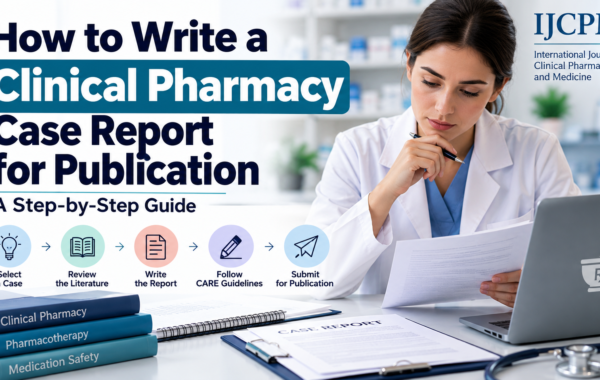
How to Write a Clinical Pharmacy Case Report for Publication: A Step-by-Step Guide by IJCPM
A practical guide for clinical pharmacists, pharmacy students, and healthcare researchers Clinical pharmacy case…
 Guides
How to Become a Clinical Pharmacist: A Complete Guide
If you enjoy science, patient care, and problem-solving, learning how to become a clinical…
 Guides
Hospital Pharmacy: A Complete Guide
Hospital pharmacy is the branch of pharmacy practice that supports patients during hospital care.…