How to Interpret a Hospital Antibiogram: A Practical Guide for Pharmacists by The International Journal of Clinical Pharmacy and Medicine

This guide is published by the IJCPM Editorial Team for informational and professional guidance. It is an educational publication, not an academic peer-reviewed research paper, and carries no DOI. To explore peer-reviewed studies with registered Crossref DOIs, please visit our Research Articles.
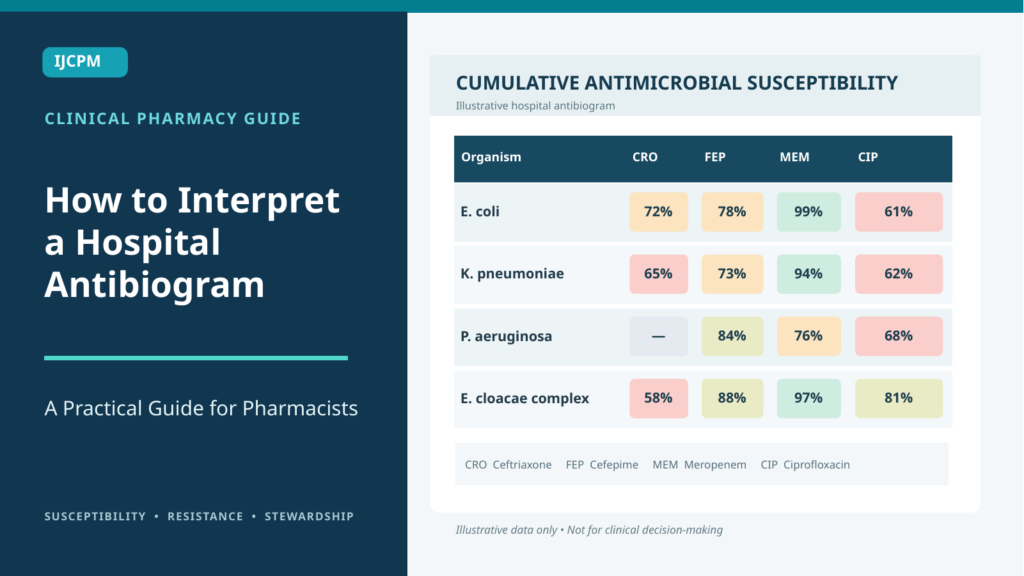
A step-by-step guide to antimicrobial susceptibility data, empirical antibiotic selection, and antimicrobial stewardship
Introduction
Antimicrobial resistance (AMR) is one of the most significant challenges facing modern healthcare. The increasing prevalence of multidrug-resistant organisms, including extended-spectrum beta-lactamase (ESBL)-producing Enterobacterales, carbapenem-resistant Enterobacterales (CRE), and resistant Pseudomonas aeruginosa, complicates the selection of effective antibiotic therapy.
For clinical pharmacists and antimicrobial stewardship teams, one of the most useful tools for making informed empirical antibiotic decisions is the hospital antibiogram.
An antibiogram summarizes the antimicrobial susceptibility patterns of bacterial organisms isolated from patients within a particular healthcare institution over a defined period. It provides local resistance information that can guide empirical antibiotic selection, support antimicrobial stewardship interventions, and identify emerging resistance trends.
However, interpreting a hospital antibiogram requires more than identifying which antibiotic has the highest susceptibility percentage. Pharmacists must understand the population represented, the number of isolates tested, the limitations of susceptibility estimates, the infection site, and the clinical characteristics of the patient.
This guide explains how to interpret a hospital antibiogram, using practical examples relevant to clinical pharmacists working in internal medicine, critical care, infectious diseases, and hospital antimicrobial stewardship programs.
The International Journal of Clinical Pharmacy and Medicine (IJCPM) provides a platform for scholarly work addressing clinical pharmacy, pharmacotherapy, medication safety, and evidence-based clinical practice.
1. What Is a Hospital Antibiogram?
A hospital antibiogram, also called a cumulative antimicrobial susceptibility report, is a summary of how frequently bacterial isolates collected within a healthcare institution are susceptible to different antibiotics.
The report is typically organized by bacterial species and antimicrobial agent.
For each organism, the antibiogram displays the percentage of tested isolates classified as susceptible to a particular antibiotic.
For example, a hospital antibiogram may report:
- Escherichia coli: 72% susceptible to ceftriaxone.
- Klebsiella pneumoniae: 65% susceptible to piperacillin-tazobactam.
- Pseudomonas aeruginosa: 84% susceptible to cefepime.
- Staphylococcus aureus: 68% susceptible to oxacillin.
These percentages are illustrative and do not represent actual institutional surveillance findings.
What does 72% susceptibility mean?
If an antibiogram shows that 72% of E. coli isolates are susceptible to ceftriaxone, approximately 72 of every 100 tested isolates were classified as susceptible under the laboratory’s testing criteria.
The remaining isolates were not classified as susceptible.
This does not mean that ceftriaxone has a 72% clinical cure rate. Microbiological susceptibility and clinical treatment success are related but different outcomes.
Treatment success also depends on antibiotic exposure, infection site, source control, host factors, organism characteristics, and disease severity.
Why are hospital antibiograms important?
Hospital antibiograms serve several purposes:
- Guide empirical antibiotic selection before patient-specific culture results become available.
- Support the development of facility-specific antimicrobial treatment guidelines.
- Identify resistance patterns among important hospital pathogens.
- Monitor changes in antimicrobial susceptibility over time.
- Support antimicrobial formulary decisions and stewardship priorities.
- Help identify areas where additional surveillance or infection prevention measures may be needed.
The Clinical and Laboratory Standards Institute (CLSI) provides detailed recommendations for developing and using cumulative susceptibility reports in its M39 guideline.
2. Understanding the Structure of a Hospital Antibiogram
Most hospital antibiograms display bacterial organisms in rows and antibiotics in columns.
Each cell shows the percentage of isolates susceptible to the corresponding antimicrobial.
Example of a hospital antibiogram
The following table is a fictional educational dataset.
Table 1. Example Hospital Antibiogram — Gram-Negative Organisms
| Organism | Number of isolates | Ceftriaxone | Cefepime | Piperacillin-tazobactam | Meropenem | Ciprofloxacin |
|---|---|---|---|---|---|---|
| E. coli | 250 | 72% | 78% | 83% | 99% | 61% |
| K. pneumoniae | 180 | 65% | 73% | 70% | 94% | 62% |
| P. aeruginosa | 120 | N/A | 84% | 80% | 76% | 68% |
| Enterobacter cloacae complex | 75 | 58% | 88% | 72% | 97% | 81% |
All figures are hypothetical. N/A indicates that an agent is not appropriate for reporting against that organism in this example. Percentages are assumed to represent isolates classified as susceptible.
How to read this table
Suppose a clinical pharmacist is assessing empirical treatment options for a hospitalized patient with suspected gram-negative bacteremia.
If E. coli is the likely pathogen, the antibiogram suggests that meropenem has the highest in-vitro susceptibility percentage among the antibiotics displayed.
However, the antibiotic with the highest susceptibility percentage is not automatically the best empirical treatment.
Meropenem is a broad-spectrum carbapenem, and its routine use for all suspected E. coli infections may encourage unnecessary carbapenem exposure.
A pharmacist should also assess the patient’s severity of illness, risk factors for resistant organisms, previous microbiology, likely infection source, and appropriate narrower-spectrum alternatives.
The antibiogram informs the decision; it does not replace clinical judgment.
3. How Is Antibiotic Susceptibility Percentage Calculated?
The susceptibility percentage represents the proportion of tested isolates categorized as susceptible to a particular antibiotic.
The basic calculation is:
Susceptibility (%) = (Number of susceptible isolates ÷ Number of isolates tested) × 100
Worked example
A hospital laboratory tests 200 eligible E. coli isolates against ceftriaxone.
Results:
- Susceptible isolates: 150
- Non-susceptible isolates: 50
- Total tested isolates: 200
The susceptibility percentage is:
(150 ÷ 200) × 100 = 75%
Therefore, the hospital antibiogram would report 75% ceftriaxone susceptibility for E. coli.
Important denominator consideration
Not every antibiotic is necessarily tested against every isolate.
For example, a laboratory may have 200 E. coli isolates in its database but only 160 with valid ciprofloxacin susceptibility results.
The ciprofloxacin percentage must use the relevant tested denominator rather than automatically using all 200 isolates.
Selective testing, suppressed reporting, and local microbiology laboratory practices can also affect apparent susceptibility percentages.
For this reason, pharmacists should review how the antibiogram was generated before interpreting individual figures.
4. Understand the CLSI Recommendations for Antibiogram Development
The CLSI M39 guideline establishes standardized methods for compiling and reporting antimicrobial susceptibility information.
Several methodological considerations are especially important.
A. Update the antibiogram regularly
Routine hospital antibiograms should generally be analyzed and presented at least annually.
Hospitals with rapidly changing resistance patterns may benefit from more frequent internal surveillance.
B. Use the first isolate per patient
For routine cumulative antibiograms, CLSI recommends excluding duplicate isolates by using the first isolate of a bacterial species from a patient during the analysis period, regardless of specimen source or susceptibility pattern.
This avoids disproportionately representing patients who undergo repeated cultures.
For example, if one patient has six positive P. aeruginosa cultures during the same reporting period, counting all six could distort the hospital’s overall susceptibility estimate.
C. Include an adequate number of isolates
The standard routine reporting recommendation is to include organism groups with at least 30 eligible isolates.
Small sample sizes produce less stable estimates and should be interpreted with caution.
For example:
- 27 susceptible isolates out of 30 = 90%.
- 270 susceptible isolates out of 300 = 90%.
Both results produce 90% susceptibility, but the estimate based on 300 isolates is more precise.
D. Use appropriate laboratory data
A reliable antibiogram should use finalized, verified susceptibility results, exclude routine surveillance cultures from its standard diagnostic dataset, and apply a consistent interpretation methodology.
E. Clearly identify the reporting period
An antibiogram should state the period during which isolates were collected.
A report from January–December 2025 may not fully reflect resistance patterns in late 2026, particularly if the hospital has experienced outbreaks or major changes in patient populations.
These recommendations help ensure that antibiogram data are suitable for informing empirical treatment decisions.
5. Understanding Susceptible, Intermediate, and Resistant Results
Individual antimicrobial susceptibility tests classify organisms into interpretive categories according to recognized breakpoints.
The meaning of these classifications is important when interpreting cumulative susceptibility reports.
| Category | General interpretation |
|---|---|
| Susceptible (S) | A high likelihood of therapeutic success when the recommended exposure is achieved |
| Intermediate (I) | Interpretation depends on the breakpoint system, drug exposure, and sometimes the infection site |
| Resistant (R) | Increased likelihood of treatment failure despite usual or increased exposure |
| Susceptible dose-dependent (SDD) | Susceptibility depends on using an appropriate dosing regimen to achieve the necessary exposure |
The exact definitions vary between CLSI and the European Committee on Antimicrobial Susceptibility Testing (EUCAST).
For example, EUCAST defines the intermediate category as susceptible, increased exposure, which is not interchangeable with every CLSI intermediate classification.
Why does this matter?
Suppose an antibiogram reports 80% susceptibility to cefepime.
The pharmacist should determine whether the hospital counts only isolates classified as susceptible or combines susceptible and other exposure-dependent categories.
For standard cumulative reports, these categories should not be combined indiscriminately.
The interpretation must be consistent with the laboratory’s breakpoint standards, dosing assumptions, and reporting methodology.
Useful references include the CLSI standards and EUCAST breakpoint resources.
6. How to Choose Empirical Antibiotics Using an Antibiogram
An antibiogram is most useful when the causative organism is not yet known and empirical treatment is required.
A practical approach involves six steps.
Step 1: Identify the most likely source of infection
Different infections are associated with different pathogens.
Examples include:
- Urinary tract infection: E. coli, Klebsiella spp., and other uropathogens.
- Hospital-acquired pneumonia: P. aeruginosa, S. aureus, and selected Enterobacterales.
- Intra-abdominal infection: Enterobacterales, anaerobes, and other organisms depending on the source.
- Catheter-associated bloodstream infection: organisms associated with the clinical setting, device, and patient risk factors.
Empirical therapy should target likely pathogens rather than every organism listed in the antibiogram.
Step 2: Determine the severity of infection
Patients with uncomplicated infections generally require a different approach from those with septic shock, severe immunosuppression, or critical illness.
Severe infections may justify broader initial coverage when resistant pathogens are reasonably suspected.
Step 3: Review patient-specific resistance risk factors
Important considerations include:
- Previous colonization or infection with resistant organisms.
- Antibiotic exposure during the preceding three months.
- Recent hospitalization.
- Prior antimicrobial susceptibility results.
- Local epidemiology and outbreak information.
- Immunocompromised status.
- Infection acquired in a healthcare facility.
The IDSA antimicrobial resistance guidance emphasizes the importance of previous culture results, recent antimicrobial exposure, infection severity, infection source, and local susceptibility patterns.
Step 4: Review the relevant antibiogram
Select the most relevant pathogen, antibiotic, clinical setting, and specimen-source data.
Step 5: Assess antibiotic appropriateness
Consider:
- Expected antimicrobial activity.
- Infection-site penetration.
- Renal and hepatic function.
- Allergy history.
- Toxicity risks.
- Drug interactions.
- Dosing and pharmacokinetic/pharmacodynamic targets.
- Local formulary availability.
Step 6: Reassess therapy after microbiology results
Once cultures and susceptibility results become available, empirical treatment should be reassessed and narrowed, changed, or discontinued when appropriate.
A hospital antibiogram supports initial population-level decisions; a patient’s own microbiological results provide more direct evidence for targeted treatment.
7. Practical Clinical Example: Empirical Antibiotic Selection in Urosepsis
Consider the following fictional case.
A 68-year-old man presents with fever, hypotension, tachycardia, and suspected urinary-source sepsis.
His medical history includes diabetes mellitus and recurrent urinary tract infections.
Relevant findings include:
- Temperature: 39°C.
- Blood pressure: 85/50 mmHg.
- Heart rate: 118 beats/minute.
- White blood cell count: 18.5 × 10⁹/L.
- Serum creatinine: 1.6 mg/dL.
- Lactate: 3.5 mmol/L.
- Urinalysis: pyuria and positive nitrites.
Blood and urine cultures are obtained, and the patient requires urgent antimicrobial treatment and sepsis resuscitation.
Hospital antibiogram
Assume the relevant E. coli susceptibility data are:
| Antibiotic | Susceptibility |
|---|---|
| Ceftriaxone | 72% |
| Piperacillin-tazobactam | 83% |
| Cefepime | 78% |
| Meropenem | 99% |
| Ciprofloxacin | 61% |
Clinical pharmacist interpretation
Ceftriaxone demonstrates relatively low local susceptibility against E. coli, raising concern about empirical coverage in severe infection.
Meropenem demonstrates substantially higher susceptibility in this hypothetical dataset.
However, the pharmacist should not automatically select a carbapenem based on the percentage alone.
The decision must incorporate previous ESBL isolates, recent antibiotics, suspected obstruction or other source-control needs, kidney function, severity of shock, and relevant institutional sepsis guidance.
In a patient with septic shock and a strong likelihood of ESBL-producing Enterobacterales, a carbapenem may be an appropriate initial option.
After culture results become available, the antimicrobial regimen should be reassessed according to the identified organism, its susceptibility pattern, and the patient’s clinical response.
Key learning point: The antibiogram provides an estimate of local antimicrobial activity, while patient-specific risk factors determine how that information should be used.
8. Interpreting an ICU-Specific Antibiogram
Antibiotic susceptibility patterns frequently differ between intensive care and general hospital populations.
ICU patients may have greater prior antibiotic exposure, longer hospital stays, invasive medical devices, and higher rates of resistant organisms.
As a result, a hospital-wide antibiogram may overestimate antibiotic susceptibility in some ICU populations.
Example: Pseudomonas aeruginosa susceptibility
| Antibiotic | Hospital-wide | ICU |
|---|---|---|
| Cefepime | 84% | 68% |
| Piperacillin-tazobactam | 80% | 61% |
| Meropenem | 76% | 58% |
| Ceftolozane-tazobactam | 93% | 88% |
Hypothetical data for educational use; differences assume adequate and appropriately tested isolate counts.
Interpretation
Cefepime susceptibility is 84% hospital-wide but only 68% among ICU isolates.
If a critically ill patient has suspected P. aeruginosa infection, the ICU-specific percentage may be more representative of the relevant population.
This illustrates why unit-specific antibiograms can improve the relevance of empirical antibiotic selection.
However, subgroup analyses require adequate sample sizes and must account for possible differences in which isolates were tested.
A drug with a high ICU susceptibility percentage should not automatically be chosen without considering infection site, resistance mechanisms, clinical evidence, and stewardship principles.
9. Why Higher Susceptibility Does Not Always Mean a Better Antibiotic
One of the most common mistakes in antibiogram interpretation is assuming that the antibiotic with the highest susceptibility percentage is always the preferred treatment.
Consider an antibiogram showing:
- Ceftriaxone: 85% susceptibility.
- Piperacillin-tazobactam: 90% susceptibility.
- Meropenem: 99% susceptibility.
It may seem logical to choose meropenem for every infection.
However, this approach ignores antimicrobial spectrum, patient characteristics, drug exposure, infection severity, and the potential ecological consequences of unnecessarily broad antibiotic use.
A narrower-spectrum agent with an appropriate likelihood of activity may be preferable for a clinically stable patient.
Conversely, broader initial treatment may be justified in severe illness with substantial resistance risk.
Antibiogram interpretation is therefore a risk-benefit assessment
The goal is not simply to maximize susceptibility percentages.
The goal is to select a regimen that is sufficiently likely to treat the suspected infection while minimizing avoidable toxicity and unnecessary broad-spectrum exposure.
10. Understanding ESBL and Carbapenem Resistance in an Antibiogram
Hospital antibiograms can help antimicrobial stewardship teams monitor changing resistance patterns.
Extended-spectrum beta-lactamases (ESBLs)
ESBL-producing Enterobacterales commonly demonstrate resistance to several penicillins and cephalosporins.
A declining ceftriaxone susceptibility percentage among E. coli or Klebsiella pneumoniae may raise concern about increasing resistance, including ESBL-associated resistance.
However, ceftriaxone resistance does not independently confirm that an organism produces an ESBL.
Confirmation or classification depends on laboratory methods, organism characteristics, and local reporting practices.
Carbapenem-resistant Enterobacterales
Reduced carbapenem susceptibility is another important concern.
For example, a decline in meropenem susceptibility among K. pneumoniae isolates may warrant investigation.
However, an antibiogram cannot determine whether resistance is caused by KPC, NDM, OXA-48-like enzymes, or other mechanisms.
Additional laboratory testing may be required.
The IDSA 2026 guidance on antimicrobial-resistant gram-negative infections addresses ESBL-producing Enterobacterales, AmpC-producing organisms, CRE, difficult-to-treat resistant P. aeruginosa, carbapenem-resistant Acinetobacter baumannii, and Stenotrophomonas maltophilia.
Why resistance mechanisms matter
Two organisms with similar susceptibility patterns may have different underlying resistance mechanisms.
These differences can affect the selection of newer beta-lactam/beta-lactamase inhibitor combinations and other antibiotics.
An antibiogram identifies population-level susceptibility patterns; it does not replace patient-level resistance mechanism testing.
11. How to Monitor Antibiotic Resistance Trends Over Time
Antibiograms can be compared across reporting periods to identify changes in local susceptibility.
Example: Ceftriaxone susceptibility among E. coli
| Year | Susceptibility |
|---|---|
| 2023 | 86% |
| 2024 | 81% |
| 2025 | 76% |
| 2026 | 70% |
Fictional surveillance data.
The change from 86% to 70% represents a decline of 16 percentage points over the displayed period.
A pharmacist might interpret this as a possible emerging resistance trend requiring further investigation.
However, year-to-year comparisons should consider:
- Changes in patient population.
- Sample size and statistical uncertainty.
- Infection prevention practices.
- Changes in laboratory methods or breakpoints.
- Duplicate-isolate exclusion.
- Changes in specimen sources.
- Antimicrobial prescribing patterns.
- Introduction of new diagnostic methods.
A trend in susceptibility percentage is not necessarily proof that a particular prescribing practice caused the change.
Using trends in antimicrobial stewardship
Hospitals may use these findings to review empirical treatment guidelines, investigate resistance clusters, prioritize antimicrobial use evaluations, and strengthen infection prevention activities.
12. Common Mistakes When Interpreting an Antibiogram
Mistake 1: Using the highest susceptibility percentage without considering the patient
Clinical context always matters.
Mistake 2: Ignoring the number of isolates
A 100% susceptibility estimate derived from 12 isolates is much less reliable than one derived from several hundred appropriately selected isolates.
Mistake 3: Using outdated antibiograms
Resistance patterns may change, especially during outbreaks or changes in hospital epidemiology.
Mistake 4: Applying hospital-wide data to every department
ICU, hematology, oncology, neonatal, and general medicine patients may have different susceptibility profiles.
Mistake 5: Ignoring infection-site differences
Urinary isolates and bloodstream isolates may have different resistance profiles.
An antibiotic that achieves adequate urinary concentrations may not be suitable for bacteremia or pneumonia.
Mistake 6: Misinterpreting susceptibility as clinical success
An 85% susceptible result is not an 85% cure rate.
Mistake 7: Assuming antibiotics were tested against every isolate
Variable testing practices can influence the reported percentages.
Mistake 8: Using empirical susceptibility estimates after individual culture results become available
Patient-specific susceptibility results should generally guide definitive antibiotic selection, alongside clinical circumstances and established treatment recommendations.
Mistake 9: Ignoring intrinsic resistance
An antibiogram should not be interpreted as overriding an organism’s known intrinsic resistance or an antimicrobial’s lack of appropriate clinical activity.
Mistake 10: Ignoring uncertainty in very small subgroups
A specialized antibiogram may be more clinically relevant but statistically less reliable if the subgroup contains few isolates.
13. The Role of Clinical Pharmacists in Hospital Antibiogram Interpretation
Clinical pharmacists play an important role in translating microbiology data into safe and appropriate antimicrobial use.
Their responsibilities may include:
Empirical antibiotic recommendations: Helping clinicians select initial treatment based on the likely pathogen, infection source, patient risk factors, and local susceptibility.
Antimicrobial stewardship interventions: Reviewing unnecessarily broad-spectrum treatment and recommending appropriate optimization.
Development of hospital treatment guidelines: Supporting institution-specific recommendations using local microbiological evidence.
Resistance surveillance: Collaborating with microbiologists and infection prevention teams to identify concerning trends.
Education: Teaching physicians, pharmacists, nurses, and trainees how to understand susceptibility data.
Formulary evaluation: Contributing local microbiology evidence to decisions about antimicrobial formulary additions or restrictions.
Clinical decision support: Helping integrate locally validated susceptibility information into electronic prescribing systems and antimicrobial stewardship dashboards.
The CDC Core Elements of Hospital Antibiotic Stewardship Programs emphasize pharmacy expertise, interventions, antimicrobial use tracking, reporting, and education as important components of successful stewardship programs.
These activities illustrate how antibiogram interpretation contributes to broader patient safety and medication optimization.
14. From Traditional Antibiograms to Enhanced Antibiograms
Traditional hospital antibiograms provide useful summaries but cannot answer every clinical question.
Enhanced antibiograms offer additional information that may improve clinical relevance.
Unit-specific antibiograms
These summarize susceptibility among patients from particular hospital departments.
Examples include ICU, oncology, and surgical units.
Specimen-specific antibiograms
These report susceptibility patterns separately for urine, blood, respiratory, and other specimens.
Syndrome-specific antibiograms
These aim to estimate antibiotic coverage for clinical syndromes such as urinary tract infection or hospital-acquired pneumonia.
Unlike conventional organism-specific reports, syndrome-specific approaches require consideration of the relative frequency of different pathogens.
Combination antibiograms
These estimate the potential coverage associated with two-antibiotic combinations based on isolate-level susceptibility patterns.
For example, a combination antibiogram may estimate the percentage of P. aeruginosa isolates susceptible to at least one agent in a proposed combination.
However, these analyses do not prove that combination therapy improves clinical outcomes or that two antibiotics act synergistically.
Weighted-incidence syndromic combination antibiograms (WISCA)
WISCA incorporates the relative frequency of pathogens and susceptibility patterns to estimate coverage for a specific infectious syndrome.
It can be useful when empirical treatment must account for multiple potential pathogens.
Enhanced reporting should be developed collaboratively by microbiology, infectious diseases, pharmacy, and antimicrobial stewardship teams.
15. How to Develop a Hospital Antibiogram
Clinical pharmacists may also participate in the development and annual review of hospital antibiograms.
A typical workflow involves several stages.
Stage 1: Data extraction
Retrieve relevant microbiology results from the laboratory information system or an appropriately validated database.
Stage 2: Data validation
Confirm organism identification, test results, specimen dates, and applicable laboratory interpretation standards.
Stage 3: Deduplication
Apply the chosen duplicate-isolate exclusion method according to the reporting purpose and CLSI recommendations.
Stage 4: Organism grouping
Group isolates by appropriate species or organism categories.
Stage 5: Susceptibility calculation
Calculate the percentage of eligible isolates classified as susceptible to each antibiotic.
Stage 6: Data quality assessment
Check denominators, testing practices, isolate counts, missing data, and breakpoint changes.
Stage 7: Report development
Produce clear antibiogram tables with reporting dates, sample sizes, relevant footnotes, and methodological information.
Stage 8: Clinical review
Review findings with infectious diseases specialists, microbiologists, clinical pharmacists, and antimicrobial stewardship teams before implementing guideline changes.
Stage 9: Distribution and education
Publish the approved antibiogram through institutional clinical resources and educate healthcare professionals on its appropriate use.
Stage 10: Continuous surveillance
Monitor resistance trends, update relevant prescribing recommendations, and investigate important changes.
The official CLSI M39 resource provides detailed methods for these activities.
16. Practical Checklist: How to Interpret a Hospital Antibiogram
Before using an antibiogram to inform empirical antibiotic therapy, pharmacists should answer the following questions:
- Is the antibiogram sufficiently recent?
- Does it represent the appropriate healthcare facility?
- Is a unit-specific or specimen-specific version available?
- Are there enough isolates to support meaningful interpretation?
- Were duplicate isolates appropriately excluded?
- Are testing methods and breakpoints appropriate?
- What organisms are most likely to cause the suspected infection?
- Which antibiotics demonstrate adequate local susceptibility?
- Does the patient have previous resistant organisms?
- Has the patient received recent antibiotic treatment?
- Is the infection severe or associated with shock?
- Will the selected antibiotic achieve adequate exposure at the infection site?
- Are there patient-specific safety or dosing concerns?
- Can therapy be narrowed after culture results become available?
This checklist provides a practical framework for incorporating local microbiology evidence into antimicrobial prescribing decisions.
Frequently Asked Questions About Hospital Antibiograms
What is an antibiogram in a hospital?
A hospital antibiogram is a cumulative report summarizing the antimicrobial susceptibility of bacterial isolates collected from patients over a defined period. It helps clinicians understand local resistance patterns and informs empirical antibiotic treatment.
How do you interpret antibiogram percentages?
An antibiogram percentage represents the proportion of tested isolates classified as susceptible to a particular antibiotic. For example, 80% susceptibility means that 80% of the included tested isolates were categorized as susceptible, not that the antibiotic achieves an 80% clinical cure rate.
What is a good susceptibility percentage for empirical antibiotic selection?
There is no universal susceptibility threshold suitable for every infection.
Some institutional treatment pathways use susceptibility targets such as 80%, 90%, or higher, depending on infection severity and clinical context. These are context-dependent decision thresholds, not universal CLSI rules.
Critically ill patients may require a higher degree of confidence in active empirical therapy than patients with mild infections.
Why is the minimum of 30 isolates important?
CLSI recommends at least 30 eligible isolates for routinely reported organism-level cumulative susceptibility data. Smaller sample sizes can produce unstable estimates and increase uncertainty.
How often should hospitals update an antibiogram?
Routine cumulative antibiograms should generally be analyzed and presented at least annually. Additional surveillance may be useful when significant changes in resistance patterns occur.
What is the difference between a hospital-wide and ICU antibiogram?
A hospital-wide antibiogram summarizes susceptibility across the institution. An ICU antibiogram analyzes isolates from intensive care patients and may better represent the resistance patterns encountered in that setting.
Can an antibiogram identify ESBL-producing organisms?
An antibiogram can reveal resistance patterns suggestive of ESBL production, but it does not independently confirm the presence of ESBL enzymes. Specific microbiological methods and laboratory interpretation are required.
Can a hospital antibiogram replace culture and sensitivity testing?
No. An antibiogram provides population-level susceptibility information, primarily useful for empirical therapy. Individual patient cultures and antimicrobial susceptibility testing provide more specific evidence for definitive treatment.
What is the role of a clinical pharmacist in antibiogram development?
Clinical pharmacists help interpret susceptibility patterns, evaluate antibiotic utilization, recommend empirical therapy, monitor resistance trends, develop antimicrobial stewardship recommendations, and educate healthcare professionals.
How can antibiograms improve antimicrobial stewardship?
Antibiograms help stewardship teams select appropriate empirical regimens, identify emerging resistance patterns, develop facility-specific treatment guidelines, and monitor the need for changes in antimicrobial prescribing practices.
Conclusion
Understanding how to interpret a hospital antibiogram is an essential skill for clinical pharmacists involved in infectious diseases management and antimicrobial stewardship.
An antibiogram provides valuable information about local antimicrobial susceptibility patterns, but its interpretation must consider isolate numbers, clinical setting, infection source, resistance mechanisms, laboratory methodology, and patient-specific factors.
Pharmacists should avoid relying exclusively on the highest susceptibility percentage when selecting empirical antibiotic therapy. Instead, they should combine local microbiological evidence with clinical assessment, current treatment guidelines, pharmacokinetic and pharmacodynamic considerations, and antimicrobial stewardship principles.
As antimicrobial resistance continues to evolve, accurate antibiogram development, regular updates, and appropriate clinical interpretation will remain important components of evidence-based antibiotic use.
The International Journal of Clinical Pharmacy and Medicine (IJCPM) encourages scholarly engagement with clinical pharmacy research, antimicrobial stewardship, pharmacotherapy optimization, and medication safety.
Healthcare professionals interested in these fields can explore the journal at www.ijcpm.com.
References and Further Reading
- Clinical and Laboratory Standards Institute. M39: Analysis and Presentation of Cumulative Antimicrobial Susceptibility Test Data. Fifth edition. CLSI; 2022. https://clsi.org/shop/standards/m39/
- Infectious Diseases Society of America. IDSA 2026 Guidance on the Treatment of Antimicrobial-Resistant Gram-Negative Infections. Published July 30, 2026. https://www.idsociety.org/practice-guideline/amr-guidance/
- Centers for Disease Control and Prevention. Core Elements of Hospital Antibiotic Stewardship Programs. https://www.cdc.gov/antibiotic-use/hcp/core-elements/hospital.html
- European Committee on Antimicrobial Susceptibility Testing. Clinical Breakpoints and Antimicrobial Susceptibility Testing Resources. https://www.eucast.org/clinical_breakpoints
- International Journal of Clinical Pharmacy and Medicine (IJCPM). Official Journal Website. https://ijcpm.com/
Educational publication prepared for the International Journal of Clinical Pharmacy and Medicine (IJCPM). The clinical scenarios and antibiogram datasets are fictional and intended for educational purposes. Antibiotic decisions should follow current institutional policies, patient-specific microbiology, and relevant clinical practice guidelines.

Conducting Original Clinical Research?
Submit your empirical manuscript to International Journal of Clinical Pharmacy and Medicine. Benefit from rigorous double-blind peer review, Crossref DOI indexing, open-access distribution, and rapid editorial decisions.
 Guides
How to Write a Clinical Pharmacy Case Report for Publication: A Step-by-Step Guide by IJCPM
A practical guide for clinical pharmacists, pharmacy students, and healthcare researchers Clinical pharmacy case…